

Why 2026 Is the Year to Master Car Rentals
The car rental industry has undergone a fundamental transformation in recent years, and 2026 marks a genuine turning point for anyone who rents vehicles regularly or occasionally. Dynamic pricing algorithms, expanding electric vehicle fleets, new fee structures, and an increasingly complex web of insurance options mean that booking a car today requires a different kind of preparation than it did even five years ago. Whether you are collecting a vehicle at an international airport, booking through a local agency for a road trip, or securing a longer-term rental for a work assignment, understanding the modern car rental landscape is essential to getting good value and avoiding costly surprises. The principles that separate confident, informed renters from those who leave the counter overpaying apply consistently across every destination and every vehicle category.
This guide has been built to give you a complete framework for navigating car rentals in 2026 — covering pricing, insurance, booking strategy, vehicle selection, and damage protection. The approach mirrors what the most effective review and comparison platforms do across every sector: instead of surface-level summaries, we go deep on what actually matters. Just as the nejlepší online casino platforms earn their rankings by offering transparency, fair terms, and genuine user value, the best car rental experiences are built on exactly the same foundation — honest pricing, clear conditions, and no unpleasant surprises when you return the keys.
Understanding 2026 Car Rental Pricing
How Dynamic Pricing Works — and How to Use It to Your Advantage
Car rental rates in 2026 are governed by algorithms that process dozens of variables simultaneously: local demand, fleet availability at specific locations, competitor pricing, weather forecasts, and the number of days remaining before your pickup. This means the same vehicle at the same branch can cost substantially more or less depending purely on when you search. Experienced analysts in the review and comparison space — including those responsible for the rigorous platform evaluations published at https://czkasino.cz/ — apply a similar analytical approach to their work: headline numbers rarely tell the full story, and the most valuable insights come from examining the underlying mechanics rather than the most prominent figure on the page. In rental pricing, this means tracking rates over time rather than accepting the first quote you see.
The optimal advance booking window for most destinations sits between two and eight weeks before pickup. Booking further out can mean you miss promotional price drops that rental companies release to move inventory during quiet periods. Waiting until the final days is a gamble that occasionally pays off in slow markets but more frequently results in reduced choice and elevated prices during peak season. The practical strategy is to book a flexible, free-cancellation rate early, then monitor your options and rebook if a material saving appears — a pattern that rewards patience and attention in the same way that informed decision-making rewards anyone navigating a competitive, complex market.
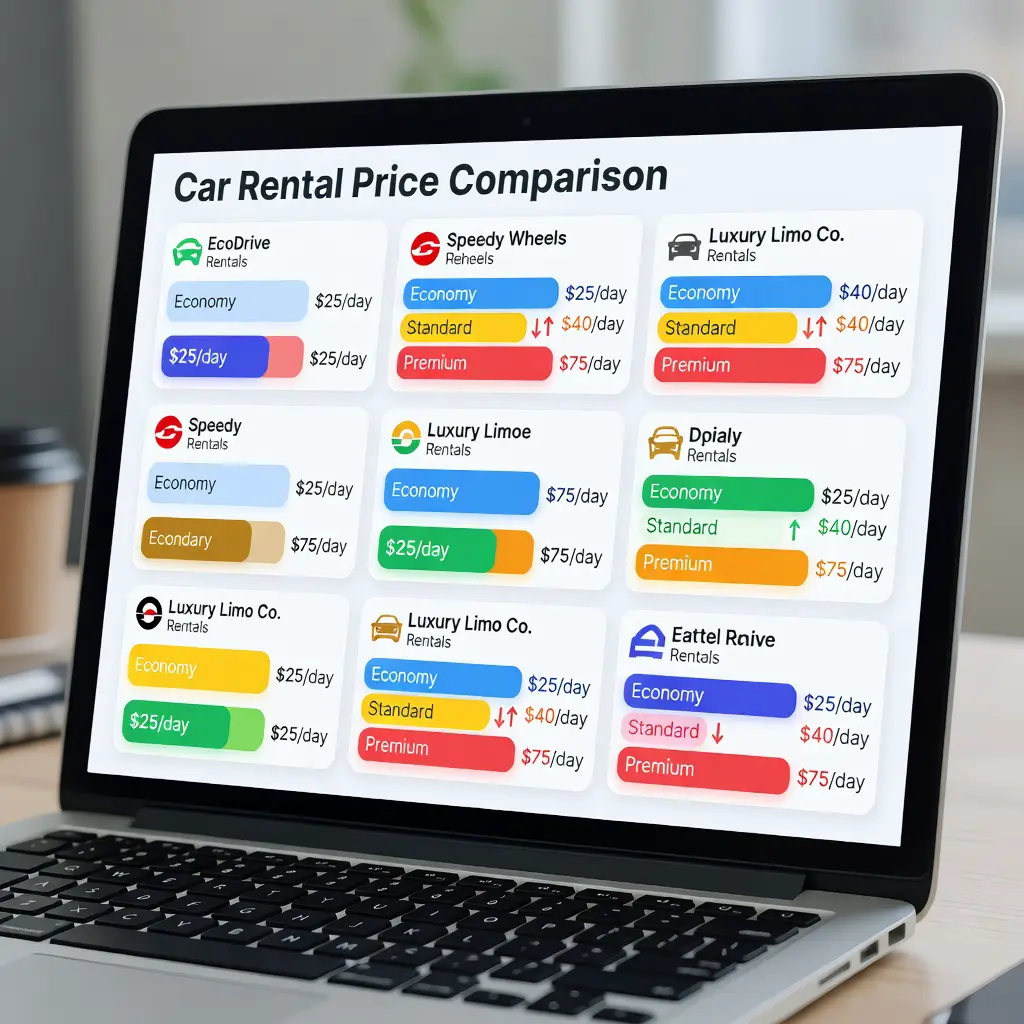
One of the most reliable and consistently underused strategies is comparing off-airport branch pricing directly against airport locations for the same company. Airport concession fees — charges that rental operators pay for the right to operate within or adjacent to terminal buildings — are passed directly to the customer and can add between 15% and 30% to your total cost. A short taxi or rideshare journey to a nearby city-centre branch of the same company often costs far less than that surcharge, particularly on rentals lasting more than two days. Much like how casino review analysts note that the most prominently advertised option is rarely the best-value one, the most convenient rental location is rarely the most affordable.
Decoding the True Cost of Any Rental
The advertised daily rate for a car rental is almost never what you pay. A rigorous comparison of rental offers requires examining every component that contributes to the final bill — an approach that experienced reviewers in any information-intensive field apply as a matter of discipline. The following table maps the primary cost components you must evaluate before confirming any booking.
| Cost Component | Key Considerations | Typical Price Impact |
|---|---|---|
| Base daily rate | Varies by booking timing, channel, and membership status | Core cost benchmark |
| Collision Damage Waiver (CDW) | Often duplicated by credit card coverage — verify before paying | +20% to +50% |
| Theft Protection (TP) | Sometimes bundled with CDW, sometimes sold separately | +10% to +25% |
| Fuel policy | Full-to-full is almost always best; prepaid fuel rarely saves money | +10% to +35% |
| Additional driver fees | Typically €10–€15/day; sometimes waived for spouses | +5% to +20% |
| Young driver surcharge | Under 25, sometimes under 30 in certain markets | +15% to +35% |
| Airport and facility fees | Applied automatically at all airport-located branches | +15% to +30% |
| GPS and peripheral extras | Rarely necessary — smartphone navigation is superior and free | +€5 to €15/day |
| One-way drop fee | Can be substantial for cross-country or cross-border returns | +€50 to €300+ |
When you aggregate these elements, the base daily rate frequently represents less than half of your actual final bill. Always request a fully itemised cost breakdown before confirming any reservation, and compare totals — not daily rates — when assessing competing offers. Any platform that does not display the full price including all fees and taxes before you confirm is obscuring information that directly affects your decision. This is the same principle that distinguishes trustworthy review aggregators from misleading ones in any field: transparency of true cost is the fundamental quality criterion.
Car Rental Insurance: What You Actually Need
Understanding What You Are Being Offered at the Counter
Insurance upselling at the rental counter is the primary mechanism through which rental companies improve their margins — and the primary mechanism through which underprepared renters overpay. At the desk, you will typically be presented with a Collision Damage Waiver, a Super CDW, a Theft Protection product, and often Personal Accident Insurance. Understanding which of these overlap with coverage you already have — through your credit card, travel insurance, or personal auto policy — is critical before pickup day. For a rigorous side-by-side breakdown of rental insurance products against credit card coverage across different scenarios, our guide on rental insurance coverage examines exactly where each product applies and where the genuine gaps appear.
Evaluating car rental insurance closely mirrors how informed users approach the terms and conditions of any complex financial or entertainment product. Specialist casino review platforms have developed meticulous evaluation frameworks for assessing bonus terms, withdrawal conditions, and wagering requirements precisely because the gap between what is advertised and what is delivered can be substantial. Car rental insurance works the same way: the headline coverage sounds comprehensive, but the exclusions — tyres, windscreen, undercarriage, roof damage, and single-vehicle incidents on many standard CDW products — define your actual exposure. Read the exclusions, not just the coverage summary.
Credit Card Rental Coverage: When It Works and When It Does Not
Many premium and gold-tier credit cards include primary or secondary rental car insurance as a cardholder benefit, but the conditions attached to this coverage are highly specific and frequently misunderstood. Primary coverage activates without involving your personal auto insurer; secondary coverage responds only after your own policy pays first. For international travel, primary coverage cards are significantly more valuable. Before relying on card coverage for any rental, confirm each of the following:
- The full rental cost must be charged to the qualifying card at pickup to activate coverage
- You must explicitly decline the rental company's CDW — simply not purchasing it through a third-party platform is not sufficient
- Confirm whether the destination country is covered — Italy, Ireland, Israel, and Jamaica are commonly excluded under many card policies
- Verify the vehicle category qualifies — luxury vehicles, pickup trucks, vans over a certain weight, and exotic cars are frequently excluded
- Check the maximum claim cap, which may be lower than the replacement value of a premium vehicle
- Understand the documentation requirements before you need them — police reports, agency damage assessments, and rental receipts are typically mandatory for any claim

If your card offers primary coverage in your destination country and your chosen vehicle category qualifies, declining the rental company's CDW is financially sound and well-supported by the coverage you have already paid for — potentially saving €15 to €40 per day on a standard compact or midsize vehicle rental.
Avoiding the Traps That Cost Renters the Most
Pre-Existing Damage and How to Protect Yourself
Disputes over pre-existing vehicle damage are among the most consistently reported post-rental complaints and among the most preventable. Rental companies have an inherent incentive to attribute pre-existing damage to the returning customer, and without clear evidence captured at pickup, the burden of proof falls on you. Before leaving the lot, document every panel, every glass surface, all four tyres, the roof, the undercarriage where accessible, and all interior surfaces — with timestamped photographs and a continuous video walkthrough. This methodical documentation process functions much like the verification frameworks that serious review analysts apply when assessing operator conduct: detailed, systematic, and designed to protect you if a dispute arises later. For a complete step-by-step counter checklist covering every common trap, our guide on hidden fees protection gives you a practical tool you can apply at every pickup.
One detail that renters consistently overlook: ensure the pickup agent co-signs your damage report, and keep your own signed copy before driving away. If the agent declines to sign, note their name and the time on your own copy and photograph the unsigned form alongside the vehicle. This documentation is your primary defence if a charge appears on your statement weeks after you have returned home.
Fuel Policy Pitfalls and the Prepay Trap
Fuel policies have become an increasingly complex source of post-rental charges. The standard model — full-to-full, collecting the vehicle with a full tank and returning it with a full tank — remains the most cost-effective option in nearly all situations. The prepay model, where you purchase a full tank upfront at a guaranteed rate and return the car at any fuel level without refund, is almost universally a poor deal: you pay an above-market per-litre rate and forfeit any unused fuel remaining at return. Some companies have also introduced partial-tank threshold charges, automatically billing for a full tank if you return below a quarter. Avoid prepay fuel unless the guaranteed rate is genuinely lower than local pump prices and you are highly confident you will return the vehicle nearly empty — a combination that almost never occurs in practice.
A Proven Booking Process for 2026
Applying the following structured sequence consistently will produce better rental outcomes than any single booking hack or platform-specific shortcut. This is the kind of disciplined, repeatable process that generates reliable results across any complex comparison task — whether you are evaluating rental agencies, reviewing financial products, or assessing online entertainment platforms against specialist-curated rating criteria.
- Use a comparison aggregator to establish baseline pricing across multiple agencies for your specific dates and pickup location — treat this as a research tool, not a booking platform.
- Visit the direct websites of your top two or three shortlisted companies to identify rate differences, direct booking discounts, or fee waivers unavailable through third-party channels.
- Check for membership, employer affiliation, or loyalty programme discounts before paying the public rate — frequent flyer partnerships and credit card travel portals routinely offer 10% to 20% reductions.
- Book a flexible free-cancellation reservation at your best identified rate and set a calendar reminder to check pricing again three to five days before pickup.
- Read recent reviews specifically for the branch you will be using — not just the company's aggregate score — focusing on pickup experience, billing accuracy, and post-rental dispute handling.
- Confirm your insurance arrangement before your rental date so you arrive at the counter having already made this decision, not being persuaded into it under pressure.
- Arrive with your booking confirmation, the payment card used to book, your driving licence, and any required international driving permit for your destination.
- Complete a thorough vehicle inspection and photo documentation before leaving the lot, regardless of how the agent presents the process.

Pre-deciding every significant option before reaching the counter — insurance, fuel policy, extras, additional drivers — removes the high-pressure upsell environment from your decision-making entirely. The rental agent at the desk operates with incentives that do not align with yours. Structured advance preparation is the single most reliable way to ensure your choices reflect your actual needs and pre-researched alternatives rather than in-the-moment pressure.
Electric and Hybrid Rentals: What 2026 Renters Need to Know
Practical Considerations Before Accepting an EV
Electric vehicle availability in rental fleets has expanded significantly across European, North American, and major Asia-Pacific markets over the past two years. They offer genuine advantages — meaningfully lower running costs, a smoother and quieter driving experience, and reduced urban emissions — but they introduce considerations that traditional petrol-vehicle renters are not accustomed to. Range planning is the most critical: unlike a petrol vehicle, you cannot refuel in five minutes at any service station. You need to know where compatible charging infrastructure exists along your route, understand the difference between AC slow charging and DC fast charging speeds, and build buffer time into longer journeys. Before accepting any EV rental, confirm: which charging networks are supported under the agency's roadside assistance package, whether fast-charging infrastructure exists in your travel region, what the required return charge level is, and whether tyre wear is included in any protection waiver — EV torque places noticeably greater stress on tyres than conventional drivetrains.
Some agencies now offer dedicated EV rental packages that bundle charging credits, comprehensive tyre cover, and extended roadside assistance into a single price. These can represent better overall value than a standard EV booking with each element priced separately. Approach the comparison the same way you would evaluate any bundled service offer: map out what each element would cost individually, then assess whether the bundle represents genuine savings or merely convenience at a premium.
Insurance Nuances for Electric Vehicle Rentals
The battery pack in an electric vehicle is its most expensive component — often representing 30% to 40% of the vehicle's total replacement cost — and its treatment in insurance terms deserves specific attention. Standard CDW coverage may exclude battery damage explicitly, apply a lower claim cap than battery replacement cost, or exclude damage resulting from use of an incompatible fast-charger. Check your rental agreement and credit card coverage policy for EV-specific language before accepting an electric vehicle. Many credit card insurance programmes have not yet been updated to fully address EV-specific claim scenarios, which can leave unexpected coverage gaps that are only discovered after an incident.
Ratings, Reviews, and Making High-Information Rental Decisions
Review platforms have transformed the car rental market by making aggregated, verified post-rental experience data broadly accessible. In 2026, the volume of reviews available for most major branches at significant locations is sufficient to identify meaningful patterns in operator conduct, vehicle condition consistency, and billing transparency. But aggregate star ratings are a weak guide — the distributional detail is what matters: accuracy of vehicle condition descriptions at pickup, billing clarity, counter wait times during peak periods, and documented responsiveness to post-rental disputes. These are the dimensions that predict your individual experience, not the headline score.
This granular, methodology-driven approach to evaluation is exactly what distinguishes genuinely useful review resources from superficial ones — in any sector. For Czech and Slovak readers navigating complex comparison decisions in the online entertainment space, the detailed structured assessments available through přehled nejlepších kasin illustrate what truly reader-first evaluation methodology looks like: dimension-by-dimension analysis, verified data, and clear methodology rather than sponsored rankings. Apply that same standard of scrutiny to the car rental reviews you consult and you will rarely be caught off guard by the gap between expectation and reality.
Conclusion: Renting Smarter Every Time
The gap between what an informed renter pays and what an underprepared renter pays — for identical vehicles on identical trips — is consistently substantial. Analyses of booking behaviour estimate differentials of 30% to 50% in total rental cost between comparable journeys, driven entirely by differences in booking process, insurance decisions, and awareness of fee structures. Every principle in this guide closes a piece of that gap. The tools are not complicated: research pricing before committing, compare total costs rather than daily rates, pre-arrange your insurance, document vehicles thoroughly at every pickup, and never make high-pressure product decisions at the counter without prior preparation.
The mindset that consistently produces good outcomes in car rentals works broadly across any complex comparison task. It is the same discipline that drives reliable results when evaluating financial products, subscription services, or the online entertainment platforms assessed in depth by specialist review aggregators — the kind of rigorous, transparent evaluation that puts the reader's interests ahead of the platform's commercial incentives. Informed consumers in all these domains share one consistent habit: they read the full terms, compare on total value, and make decisions based on research rather than the most visible headline number.
The 2026 car rental market is more navigable than ever — but only for those who invest the time in genuine preparation. Use this guide as your foundational framework, stay current as pricing dynamics and fleet composition continue to evolve, and approach every rental with the preparation and confidence that comes from real expertise. The return on that preparation — measured in money saved, stress avoided, and disputes prevented — compounds meaningfully with every journey you take.



Comments
You suggest booking 2–8 weeks ahead and rebooking if a lower rate appears — what's the most reliable method to track those drops: price alerts, manual checks, or specific aggregator tools that make rebooking easy?
I didn’t realize how much airport fees can inflate the final rental price—definitely makes me rethink always grabbing a car right at the terminal.
Does the 2–8 week “optimal booking window” still apply for airport pickups during peak holidays, or is it better to lock in earlier and just keep rechecking for drops?
When you say the sweet spot is 2–8 weeks out, does that still hold for airport pickups in peak summer, or do you start seeing prices climb earlier because the fleet sells out?
Didn't realize airport branches tack on that much extra — 15 to 30 percent is no joke. I always just defaulted to the airport pickup out of convenience, but I'll definitely look at city-centre options next time I travel.
Didn't realize airport location fees could add that much — I always just went straight to the terminal desk out of habit. Next trip I'm actually going to check if there's a city branch nearby first.
Didn't realize airport branches could cost 30% more than city locations for the same company. That alone makes a big difference on a week-long rental.
Didn't realize airport pickup fees could add that much — booked off-site last summer almost by accident and saved a noticeable chunk, but had no idea the surcharge was that systematic.
Didn't know about the off-airport pricing trick before — just checked for an upcoming trip and the difference was almost 25% for a four-day rental.
I never thought about checking off-airport locations before — booked city-centre last spring and saved almost 25% compared to the airport quote for the exact same car.